

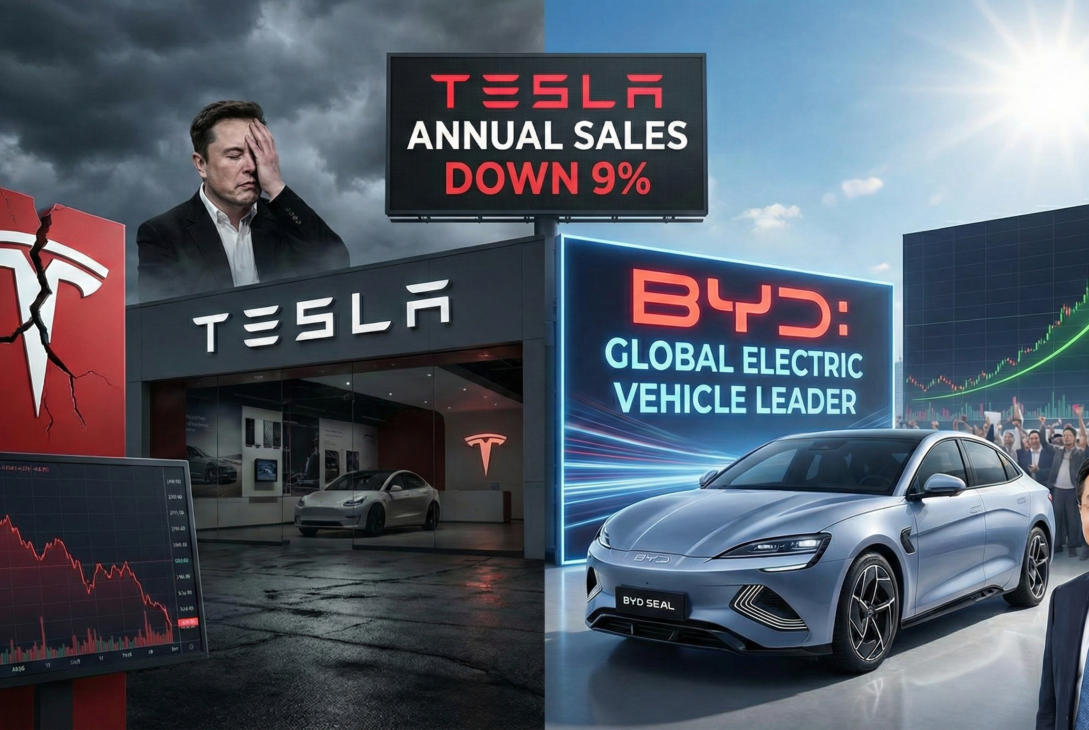
After years at the top of the global electric vehicle (EV) market, Tesla has lost its leadership position to China’s BYD, following a second consecutive year of declining annual sales. The 2025 figures signal a critical turning point not only for Tesla’s sales performance, but also for its competitive positioning in the global EV race.
Tesla reported 1.63 million vehicle deliveries worldwide in 2025, down from 1.79 million in 2024, representing a 9% year-over-year decline. This marks the second straight year of falling annual deliveries for the company.
Two key factors stand out behind this downturn:
- The removal of the $7,500 federal EV tax credit in the United States
- The aggressive global expansion of Chinese automakers, led by BYD
Q4 Numbers Raise Red Flags
Tesla delivered 418,227 vehicles in the fourth quarter of 2025, a 15.6% decline compared to the same period last year. The figure also came in well below analyst expectations, reinforcing concerns about slowing momentum.
Following the New Year holiday, the market reacted quickly. Tesla shares fell more than 2% in the first trading session of the year.
Another notable detail in Tesla’s disclosure was the performance of its “other models” category, which includes Cybertruck, Model X, and Model S. Total deliveries in this segment reached 50,850 units, suggesting that newer or niche models have yet to generate meaningful volume-driven growth.
BYD Officially Becomes the World’s Largest EV Maker
Tesla’s slowdown has coincided with a clear leadership change in the global EV market. Chinese automotive giant BYD delivered 2.26 million electric vehicles in 2025, surpassing Tesla and officially becoming the world’s largest EV manufacturer.
In Europe and China, BYD and other Chinese brands are rapidly gaining market share with:
- More affordable pricing
- Feature-rich models
- Strong state-backed manufacturing and supply chains
Although Chinese automakers are largely blocked from direct sales in the U.S. due to regulatory barriers, Tesla is still feeling growing pressure even in its home market.
The Tax Credit Effect: A Short-Term Boost, Then a Sharp Drop
The end of U.S. EV incentives played a decisive role in Tesla’s volatile sales pattern. Just before the tax credit expired, Tesla posted a record-breaking Q3 2025, delivering 497,099 vehicles, a 29% increase quarter-over-quarter.
However, this surge was largely driven by pulled-forward demand. Once the incentive ended, sales quickly cooled, and Q4 results confirmed that the earlier spike was temporary rather than structural growth.
Elon Musk’s Vision vs. Revenue Reality
The timing of Tesla’s slowdown is particularly striking given CEO Elon Musk’s ambition to reposition Tesla as a technology company, not just an automaker.
Tesla’s Master Plan IV emphasizes long-term bets on:
- Autonomous transportation
- Energy generation and storage
- Humanoid robots (Optimus)
- AI-driven ecosystems
Despite this vision, Tesla’s revenue remains heavily dependent on vehicle sales. In Q3, the company reported $28 billion in total revenue, of which $21.2 billion came directly from automotive sales.
This imbalance increases execution pressure. As EV growth slows, Tesla must accelerate the monetization of its AI, energy, and robotics initiatives—none of which yet operate at automotive-scale revenue.
Frequently Asked Questions (FAQ)
How much did Tesla’s sales decline in 2025?
Tesla’s global vehicle deliveries fell by 9% year-over-year.
How many vehicles did Tesla deliver in 2025?
Tesla delivered 1.63 million vehicles worldwide.
Who is now the world’s largest EV manufacturer?
BYD, with 2.26 million EV deliveries in 2025.
Why did Tesla’s sales drop?
Key factors include the end of U.S. EV tax incentives and rising competition from Chinese automakers.
How did Tesla perform in Q4 2025?
Q4 deliveries fell 15.6% year-over-year and missed analyst expectations.
Did the Cybertruck boost sales?
Not significantly. Combined deliveries of Cybertruck, Model X, and Model S totaled 50,850 units.
How dependent is Tesla on car sales?
Automotive sales still account for the majority of Tesla’s revenue, over 75% in recent quarters.
What risks does Tesla face going forward?
Slowing EV growth, margin pressure, and the challenge of scaling AI and robotics revenues fast enough.
Getmobil Raises $22 Million Series A with IFC and Lowercarbon Capital Participation
Follow FounderN Global on Instagram!