

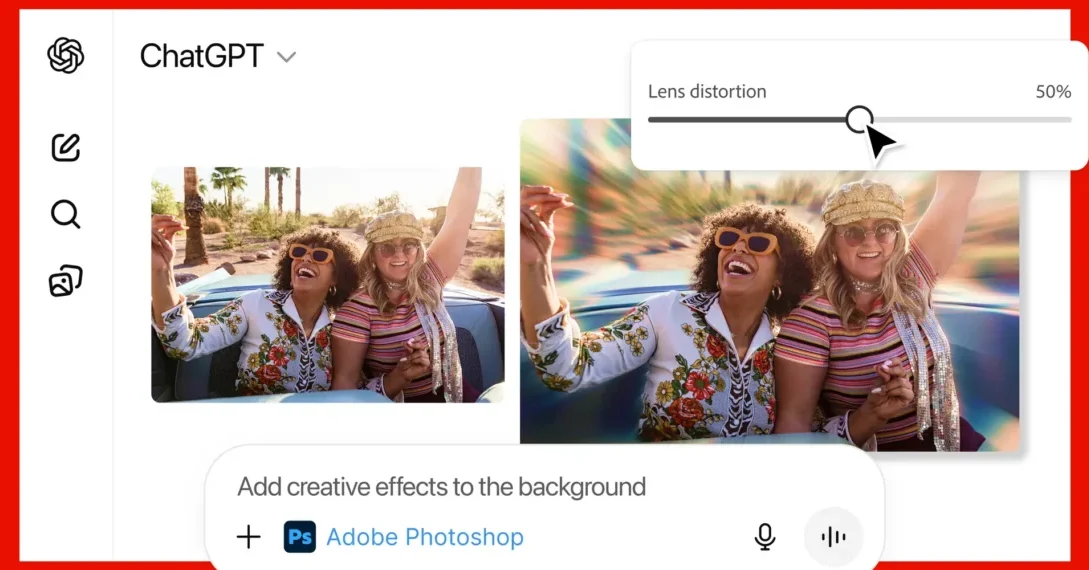
Adobe has integrated its flagship creative and document tools into ChatGPT, allowing users to edit images and summarize PDFs without leaving the chat interface.
A New Leap in Creativity and Productivity: Adobe–ChatGPT Partnership
Adobe has taken a major step to boost productivity for creative professionals and content creators by integrating core features of its flagship products—Photoshop, Express, and Acrobat—directly into ChatGPT, the AI-powered chatbot developed by OpenAI.
With this strategic partnership, users can now manage creative and document-based workflows entirely within a conversational interface, eliminating the need to switch between multiple applications.
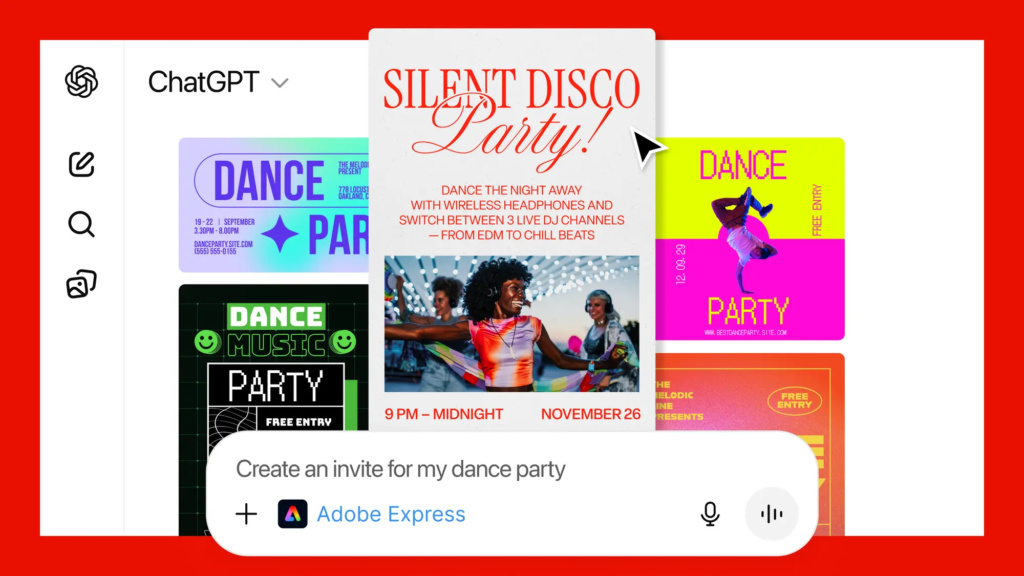
What Users Can Do Inside ChatGPT
Thanks to the integration, users can perform complex tasks using natural language commands, including:
- Removing or replacing image backgrounds
- Adding text or simple edits to photos
- Generating summaries of multi-page PDF documents
- Performing quick creative adjustments without opening Adobe apps
This approach significantly lowers the barrier for users who are not deeply familiar with advanced software interfaces and caters to those who prioritize speed and simplicity in their workflows.
Who This Is For—and Why It Matters
Adobe is clearly targeting:
- Content creators
- Marketers
- Freelancers
- Small business owners
The goal is to streamline daily workflows and make creative processes more intuitive and accessible. Strategically, the move also helps Adobe expand its reach to a broader audience while strengthening its presence in AI-driven platforms.
At the same time, the integration reinforces OpenAI’s broader vision of turning ChatGPT into a central hub for third-party applications. OpenAI has previously announced similar integrations with companies such as Canva, Spotify, Expedia, and Figma.
Platform Availability and Business Model
The new features will initially roll out across web, desktop, and iOS platforms, with Android support planned shortly thereafter. Neither Adobe nor OpenAI has disclosed details about a potential revenue-sharing model between the two companies.
The Bigger Picture
This partnership signals a shift in how professional software is consumed. Rather than forcing users into complex, standalone applications, powerful creative tools are increasingly being abstracted into AI-driven conversational layers.
For Adobe, this means staying relevant as AI reshapes creative work. For ChatGPT, it’s another step toward becoming an all-in-one productivity and creation platform.
Frequently Asked Questions About Adobe’s ChatGPT Integration
What Adobe products are integrated into ChatGPT?
Photoshop, Adobe Express, and Acrobat.
What tasks can users perform through ChatGPT?
Image editing, background removal, text additions, and PDF summarization.
Do users need advanced design skills?
No. Tasks can be completed using natural language commands.
Who is the primary target audience?
Creators, marketers, freelancers, and small business owners.
Which platforms support the new features?
Web, desktop, and iOS initially; Android support is coming soon.
Is there a revenue-sharing model between Adobe and OpenAI?
No details have been disclosed so far.
Why is this integration important?
It reduces friction in creative workflows and brings professional tools into a conversational AI environment.
Does this align with OpenAI’s broader strategy?
Yes. It strengthens ChatGPT’s role as a platform for third-party app integrations.







[…] Adobe Brings Its Creative Tools to ChatGPT, Integrating Photoshop and Acrobat […]